|
|
|
![]() Moor & Mountain |
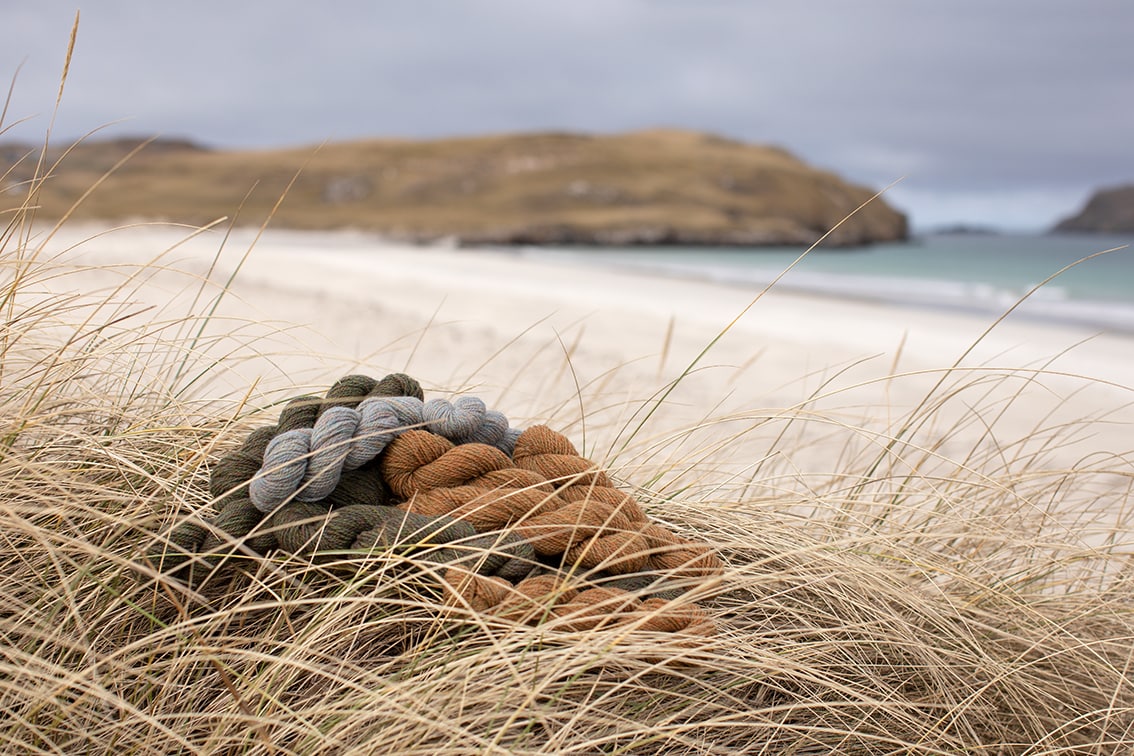
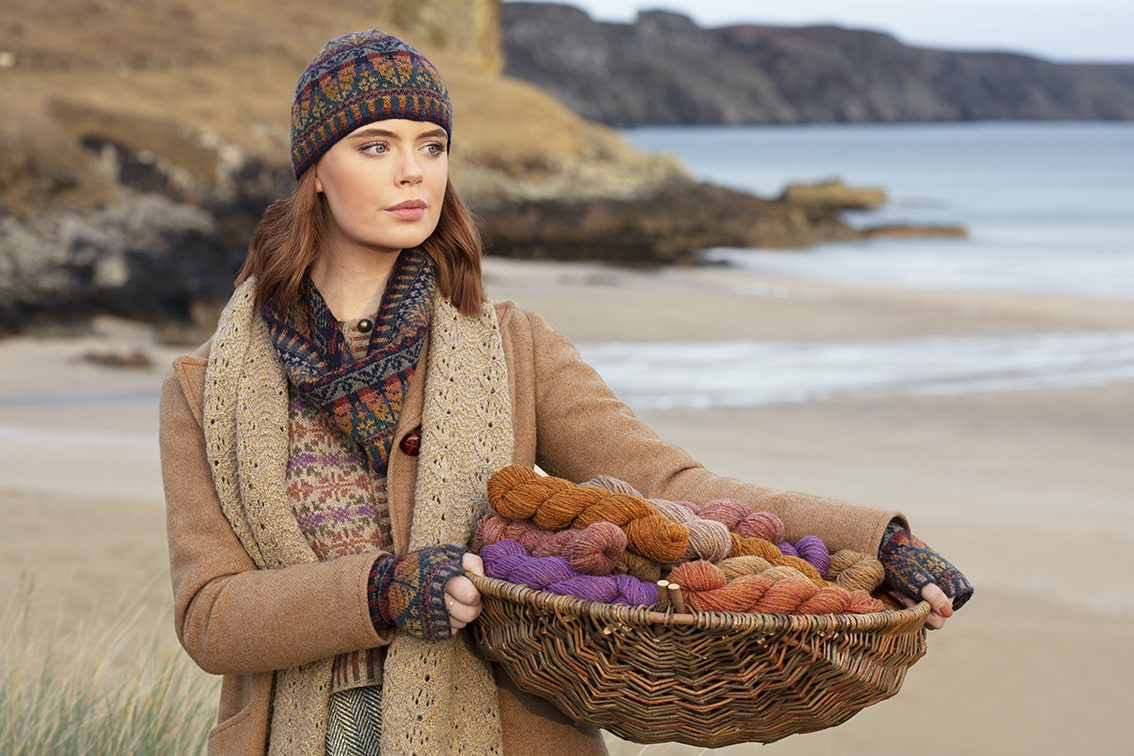
As a result, "walking the moor" is very important to me, and I share that trait with many of my fellow islanders. Some of the most committed moor-walkers are the Stornoway boys, although I should add that a "boy" in Stornoway parlance means any male between 1 and 100. The moor is embedded deeply in their consciousness for two main reasons, both of which have fins - salmon and trout. In some national parks I have seen the sign, "Take nothing but memories; leave nothing but footprints." In Lewis it would be more a case of, "Take nothing but salmon; leave no footprints for the water bailiffs to see." Technically, the salmon belong to the owners of the estates who charge premium rates to catch them, but most Lewismen regard this as iniquitous and see nothing wrong with taking one - or preferably two - for the pot, and I agree whole-heartedly as long as they are taken with a rod and not a net. Some of my earliest moorland memories are of acting as a lookout while my father landed a large salmon from the River Creed in Lewis. It could take up to half an hour to land a really big fish, and there were times when I could hardly contain my excitement, leaping up and down on the bank like a small jack-in-a-box. I don't subscribe to the macho code that some of the Stornoway boys have built up around walking the moor in the pursuit of salmon, but I understand where it comes from. You are supposed to earn your salmon. You have to walk far and stoically, and the worse the terrain, the better your soul will be for it. I think there is a heavy dose of our island Calvinism in this attitude. I will give you an example, although if you are not up for another diversion, perhaps you should skip to the next paragraph. Three Stornoway "boys" were fishing a loch that lay deep into the Lewis moor, miles from anywhere. This loch could be reached by Landrover on an estate track, but to take a vehicle would announce their presence to every bailiff in the area. They had therefore adopted the time-honoured practise of leaving their car far away in an innocuous spot, and taking a lengthy hike through the heather. They did this at 4am, which in summer is broad daylight. They planned to fish the loch until about 9am, when the fee-paying toffs would finish their breakfast and make their leisurely way down the track from the Lodge, driven by ghillies in the estate Landrovers. On this particular day the weather was beautiful, and promised to be a scorcher, so conditions were not promising for fish. Two of the threesome caught nothing, but the third had exceptional luck and landed four large, beautiful salmon. He got into his last fish dangerously close to 9am, and took a while to land it. From a point of concealment they could see the gentry coming down the track, and so they had to make a swift exit, and a detour that added several miles to their route. This detour involved an ascent around the back of a large hill, and by this time the day was very hot with no breeze. The threesome walked as the macho code dictates, swiftly, silently and stealthily, choosing ground that will leave no footprints. Poor number three, weighed down with a heavy load of salmon, was having a hard time keeping up and sweated profusely. Would his companions share his burden? No way! Unthinkable. Simply not done. Finally, number three had to insist on stopping for a rest. One and two glowered at him darkly in the midst of the glowing heather, and chorused the words that summed up their Stornoway boy philosophy in a nutshell. "It's a poor man who can't carry his own fish." There is one point of the code that I would heartily agree with, and that is never wear anything black on the moor, for it stands out like fluorescent orange. These days I am hunting for dye plants, not salmon, so it doesn't matter if I am seen or not, but I still like to blend in with my surroundings. What colour is the moor? Try and catch the wind. Look hard enough and you will see every colour somewhere. The term "heathered" is not idly chosen, for the variety of moorland colour is subtle and infinite, and cannot be pinned down to one single shade. That is why the Highlanders, in their "plaids of divers colours sundry ways divided", could keep out of sight. Likewise in the mountains that rise out of the moor in the part of our island known as Harris. The light on the land eventually brings out the full spectrum. Everyone knows that distant mountains are blue and grey. Ascend the slopes however, and you will find gold and many other colours in the hills, in the form of the myriad plants at your feet. For this section of my Hebridean yarn range, I have worked with my daughter Jade and Donald at the mill to create blends that capture different aspects of my stravaigins across moor and mountain in fair weather and foul. Look closely and I think you will be surprised at what you see there. No salmon as yet, but watch this space. It's a poor knitter who can't carry her own fish. |
|
![]() Crotal |
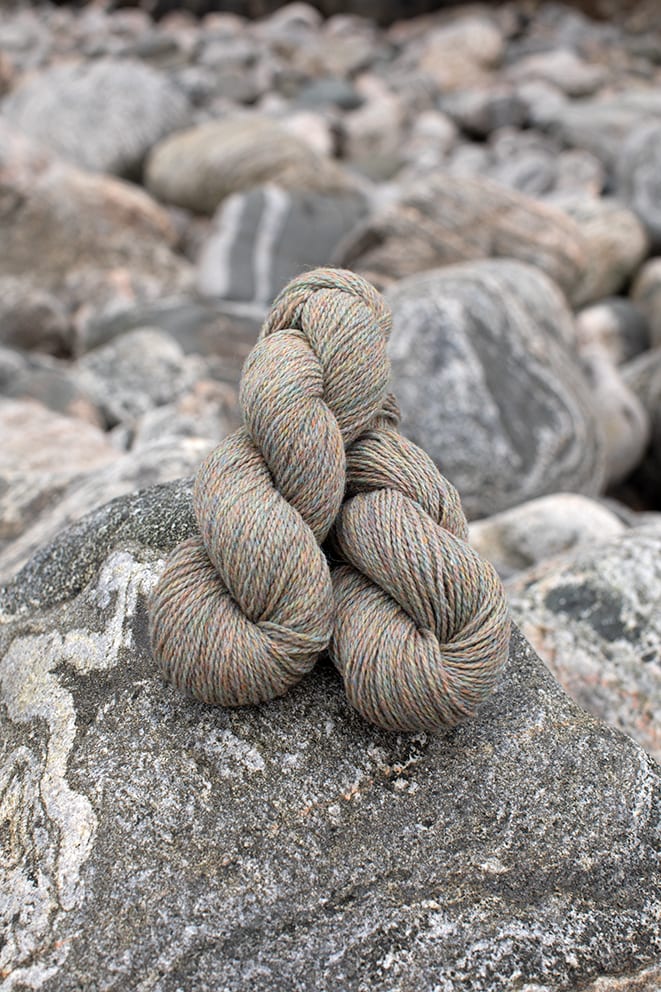
CROTALThere are several varieties of this flowerless plant in Scotland, where they are known under the general term of Crottle. I prefer the Gaelic spelling, for that is the pronunciation I have known since childhood - pronounce it with the emphasis on the first syllable. Also for childhood reasons, I refer to one particular kind of Crotal that grows abundantly on rocks in Lewis and Harris. It is quite unprepossessing in appearance, but it has the virtues of being easily available, right at the edge of rocky roads; easy to harvest, and equally easy to use. It is placed in the pot along with the wool, and brought to the boil with no additions required. After an hour or so it yields the most magnificent, deep, rich earth tones. Because of this it was widely used in tweed making, and many was the Hebridean lad who spent his youth wearing heavy sweaters dyed with Crotal. To an extent, familiarity bred contempt in the islands, and the excellence of the colour tended to be eclipsed by its ubiquity. These are different days however, and no yarn range that calls itself Hebridean can be complete without a colour that is based on the old Crotal shade. Our version is very faithful to the original - a warm, glowing brown, delicately shot through with beige and light bronze. |
|
![]() Red Deer |
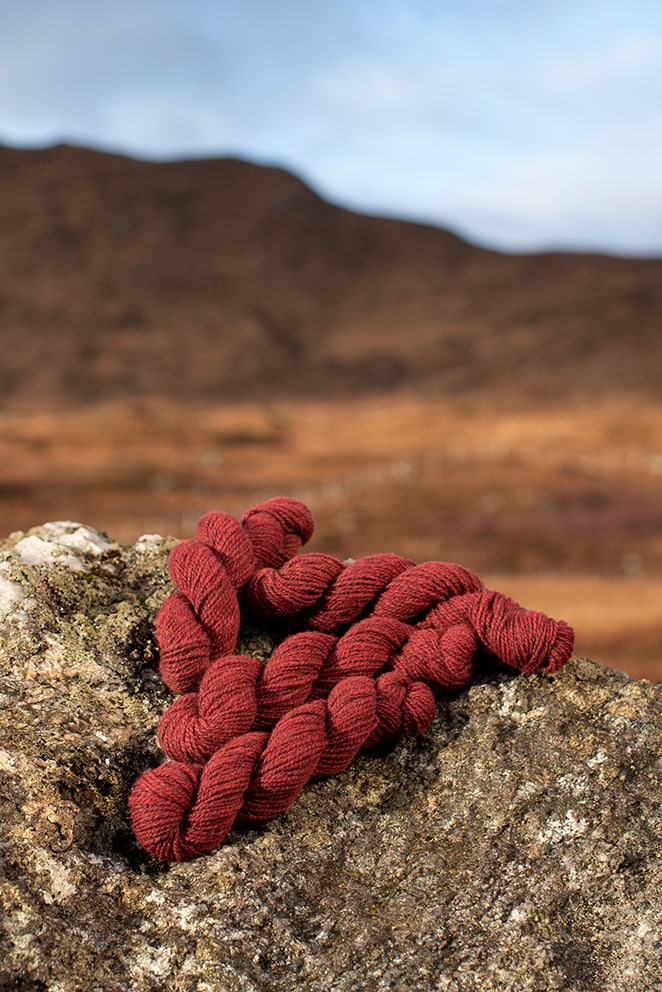
RED DEERSome of my fellow islanders have ambivalent feelings towards deer. They are beautiful creatures but they are inextricably associated with the Highland landed gentry and with the iniquities of the Highland Clearances in the 19th century. I can understand their point of view: my own ancestors were "chased out" of the Uig district of Lewis in order to clear the way for a sporting deer park. The way I see it, it was hardly the fault of the deer. Plenty of Highlanders were chased out to make way for sheep, but we still wear wool and eat mutton. My favourite place to see red deer is a mountainside in Harris known as Stulaval. The sight of sixty-odd deer coming through the rocks is one that cannot fail to impress. You have to be down-wind and very still, for one false move and they are away. My best sighting ever was just a single deer - a young stag that had strayed off on its own. It was a winter day on a very wet, very flat moor, with a low sun slanting across the landscape. There was nowhere to hide and I could hardly drop into the bogs at my feet. I froze, and the slanting sun must have blinded it, for it came closer and closer towards me, cropping the heather as it came. There was no wind whatsoever, and it came close enough for me to hear it breathing. Then of course it scented me, and was off like a bullet, its hind legs kicking up a shower of water drops and rainbows. I watched until it disappeared into the blue haze. For this shade we used the summer coats of the red deer, which are coloured a subtle tawny, tinged with rich reds that blend perfectly with the moorland, making them almost impossible to see. We have slightly intensified the flashes of red, but the effect is still one that will look perfectly at home in any landscape. |
|
![]() Bogbean |
BOGBEAN
Why on earth should you want the leaves? Reason One is a very old herbal remedy called in Gaelic, Lus Nan Laogh. It is made from the boiled leaves, and is highly effective for migraine and skin ailments such as eczema - if you can stomach it that is, for it tastes truly awful. My Uncle Donald used to brew it, and I well recall the bamboo device hanging on the wall of his barn. (Note: In his admirable Gaelic-English dictionary of 1901, Edward Dwelly cites Golden Saxifrage as being the ingredient of Lus nan Laogh. This may be so in some parts of the Highlands. In Lewis however, and I believe also in Sutherland, it is definitely Bogbean that is used.) Reason Two is the value of Bogbean as a dye plant. It was used in past times throughout the north of Scotland for the dying of plaids. It gives a wonderful yellow, but then add some iron and prepare to be amazed, for the ancient green that results is a colour that seems to have flown straight out of history. Lewis women simply used an iron pot, and obtained the green directly. However, I like to use other pots and add the iron, just to see the yarn changing colour. There will be as many different variations of this green as there are dyers, for each has their own particular method of working. I like my own, for I think it gives an exceptionally organic and vibrant shade. We have used it as the colour guide for our Hebridean version, and I am very pleased with the authenticity of the result. |
|
![]() Tormentil |
TORMENTILNOT CURRENTLY AVAILABLE You will see this plant listed as Common Tormentil in the textbooks, but I think that does it a disservice, for it is uncommonly beautiful. Potentilla Erecta is its botanic name, but that is rather a mouthful for a plant with such a tiny flower. It grows on acid moorland, as long as it is not too wet, and thrives on the banks of the stream that runs through my garden. I love the way its yellow star-like flowers peek out of the grass for the whole of summer. Dig under the delicate flowers and there is a world of interest, for the plant has reddish, tuber-like roots. These small tubers have a significance in Hebridean history, for their skin or bark yields a russet dye that was long used to colour nets, ropes and canvas sails for fishing boats. The boats I am referring to are the generation that preceded steam power, such as those known as Zulus, Fyvies and Sgoths which were used in the 19th century. I have used Tormentil for small-scale dyeing. Small-scale, for the simple reason that the labour involved in barking the fiddly little tubers is monumental. How they scraped enough to do entire sails is utterly beyond me, and I am rather well known for my patience with fine work. I do not know who did most of this particular work, but I am endeavouring to find out. I really should have asked the old Stornoway "worthies" who may well have remembered facts from way back in their boyhood. However, when I had the opportunity to ask, I was a teenager with other things on my mind, and now it is too late. They are long gone, and Stornoway's old Ropework Park, as it was known, is now a parking lot and a gardening supply centre. I badly wanted to capture the old colour of russet sails against clinkered timbers, and in our Tormentil shade, I believe I have succeeded. I have added a little extra in the form of gold traces to evoke those little yellow flowers on moor and streambank - for the simple reason that they deserve it. I will add this further small reference to Tormentil. It was penned by The Rev. Hugh Monro of the parish of Uig in Lewis for the Statistical Account of Scotland, 1791 to 1799. I like it both for the information it contains and the creative use of the non sequitur. All the woollen and linen cloth used for common purposes is spun and wove in the parish. There is only one surgeon in the whole island. All the inhabitants are of the Established Church. In the parish are four or five boat-carpenters, and several persons who make broags of leather tanned by the inhabitants with tormentil root. There are no instances known of suicide. |
|
![]() Calluna |
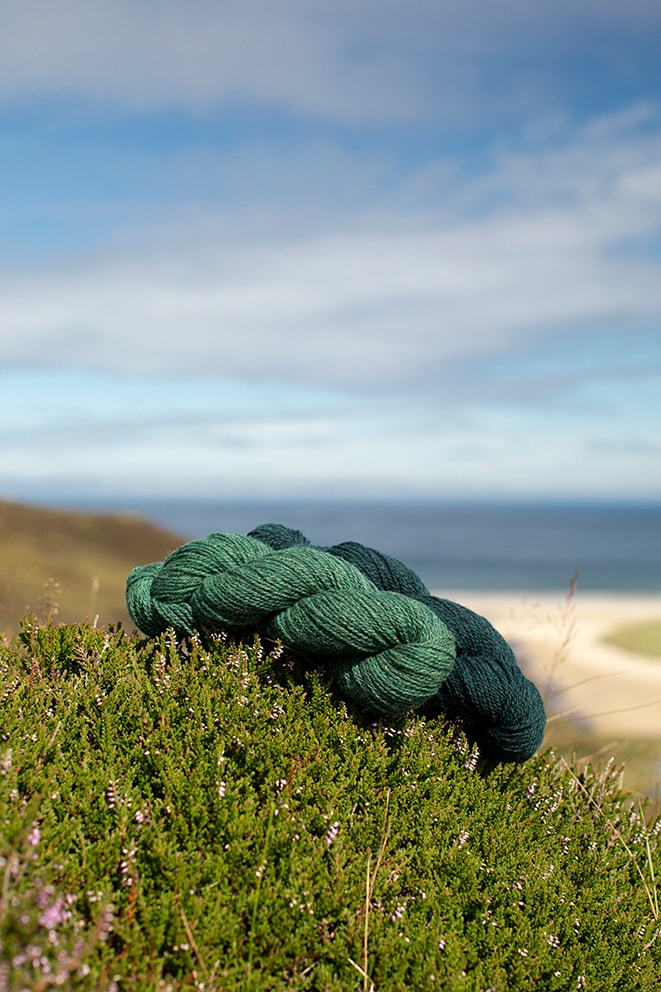
CALLUNANOT CURRENTLY AVAILABLE Calluna Vulgaris is the botanic name for the Common Heather that grows throughout the Hebrides and fires the moor with the purple of its flowers between August and September. Speaking of firing the moor, it is unfortunately legal for what is known as "muirburn" to take place in springtime, whereby the Calluna is burnt back to encourage the growth of grass. Muirburn is illegal after mid-April to protect ground-nesting birds, but that doesn't stop certain idiotic sheep barons going out in May to fire vast swathes of tinder-dry moorland. I have seen the fires glowing out of control, far into the night. On a happier note, Calluna is a dye plant so honoured in Highland history that it is the badge of the Clan Macdonald, and their Gaelic warcry was "Fraoch Eilean" - the heather isle. The colour is obtained from infusing the flowers, and will range from yellow, through orange to brown, according to the mordants used and the state of the plant when the flowers were harvested. Dried flowers will give a different shade to fresh ones, and all the shades were used for tweed-making in days before chemical dyes. The thatched roofs of Hebridean blackhouses were held in place by ropes made by twisting Calluna plants together, and heather beds were also frequently used, albeit long ago. Even within my memory, I can recall Calluna being used to clean chimneys from the top down, by attaching a thick clump to a rope, weighted at the bottom by a stone. In remote, shady glens that are sheltered from the wind, Calluna grows with such depth and vigour that it can resemble a dark green lake. I remember walking through it chest high as a child. We have sought to capture this effect by blending very dark and mid tones of green with just a whisper of lake blue. |
|
![]() Erica |
ERICA
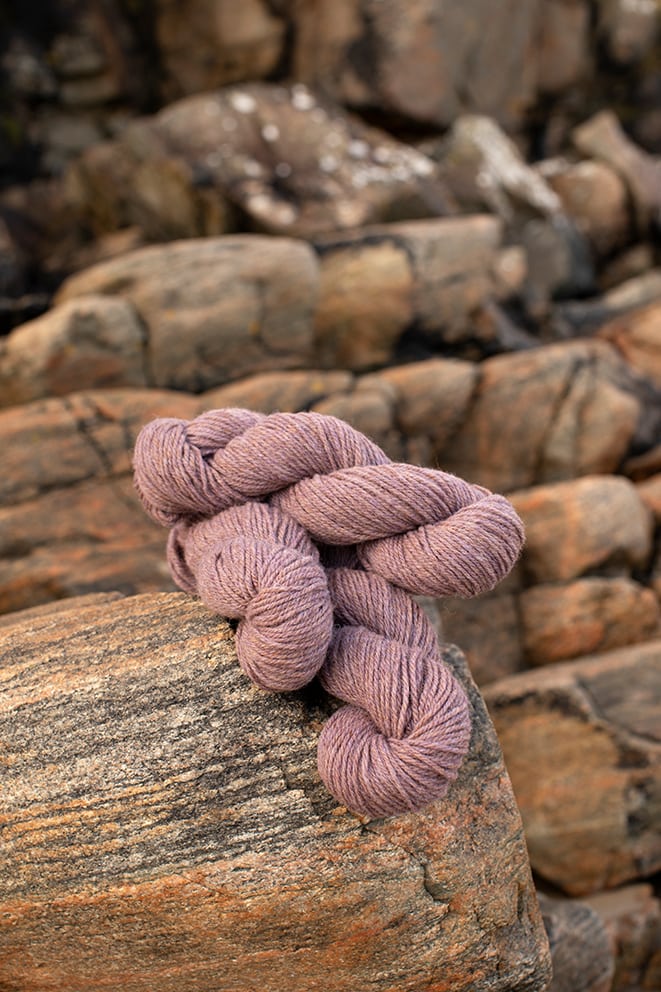
Garden shops and nurseries stock many cousins of Erica, and this is a slight sore point with me, as all my attempts to grow them have met with failure. My garden is at the edge of a moor that is rife with wild Erica and Calluna; my soil is well tended and has the right acidity, but any tame heathers that I plant seem to gradually dwindle. This seems to be the case in gardens throughout rural Lewis, yet I see them thriving in Stornoway. I will solve the mystery one day. Erica is also a valuable dye plant, for its roots can provide a spectacular purple given patience and the right mordant. Our blend is of dark red-violet with deepest purple, tinged with slivers of creamy silver to evoke Erica at its most spectacular - glistening after an early autumn shower. |
|
![]() Mountain Hare |
MOUNTAIN HAREThe Mountain Hare is certainly not prolific in the Hebrides, for in all my years of walking moor and hill, I have seen only one. Sadly, it wasn't in its white winter coat, but if it had been, then I probably wouldn't have been on the Harris hill known as the Clisham. This animal is also known as the Varying Hare, which suits it admirably, for in the three or four minutes that I had the glass on it, it didn't seem to be the same colour for ten seconds at a time. They are rarely seen, partly because I suspect their population is very small, and partly because they are mainly nocturnal. Highland legends are redolent with beautiful maidens who turn into Mountain Hares, particularly when pursued by handsome hunters, but I think we can put these tales down to wishful thinking on cold, lonely nights. The reality was good enough for me. My hare lolloped across a rocky outcrop, or I wouldn't have seen it at all, and then melded seamlessly into a patch of grass and heather. I think it should be called the Heather Hare, for like the plant, it seemed to be composed of hundreds of colours which shift according to light and wetness. We have taken the colours of the Mountain Hare as a base, and added a whole host of warm tones from pale through to dark, creating another unique blend. |
|
![]() Kelpie |
KELPIE
Mysterious disappearances in the past were more likely to be the result of clan fighting or treacherous peat bogs, but it cannot be denied that certain lochs do occasionally take on a rather sinister aspect for reasons which do not appear to be weather related. Our Kelpie colour captures the wild but beautiful shades of deep, dark vibrant blues which give such a mysterious quality to moorland lochs. Kelpie tales tend to be rather similar and all from long ago, so if you have the time here is a modern one with a difference. It is called The Kelpie and the Accordionist. It is said in the Outer Hebrides that if you have a loch right beside a mountain, then the loch will be as deep as the mountain is high. If that is true, then Loch a' Mhorghain must be very deep indeed, for a mountain called Sgaoth Iosal forms its southern edge, and its craggy sides plunge sheer and straight into the dark water. It is an impressive place and must have been terrifying in the days when legends and superstitions were closer to our lives than they are today. The road from Stornoway to Tarbert in Harris now runs along the other shore of Loch a' Mhorghain, so we now pass it in our warm comfortable cars, but even now it can cast a sinister chill when the sun dips behind the mountains and leaves the loch in deep shadow. At such times it is not hard to believe that something wicked lives down there. There is one man who certainly believes, and he has good reason to - if he can be believed himself. I make no judgement in the matter, but relay the tale to you exactly as it was told to me. Roddy C. is an excellent accordionist much in demand at dances, ceilidhs and other such functions. He loves music, good company, good drink and good food, and his imbibing of the last two have made him uncommonly tubby. He also appreciates good cars and pretty female faces, although I wouldn't care to debate which he would rank first. However, he is an old fashioned romantic who thinks that nothing is ever a lady's fault, and is blessed with a supreme sense of humour, so I suppose he could be placed in the category of loveable rogue. As well as playing for the entertainment of others, Roddy makes it his mission to pass on his skills to the young, and holds accordion classes all over the island. Several nights a week he gets into his battered old Mercedes - he needs such a car to cope with his bulk - and takes off for remote corners of the island where he happily teaches in draughty village halls. Wednesday nights are reserved for Tarbert, and it was here that one night ten years ago, he was teaching his small class as usual. Class ended at nine-thirty prompt, for Roddy wanted to get back across the border into Lewis and have a dram or two before sitting down to a substantial late supper. The accordion was stowed in the back of his car and off he went. The road from Harris to Lewis leaves Tarbert and quickly begins a long ascent into the mountains. The ascent is so marked that your ears "pop" near the summit. Half way up there is a small cluster of dwellings called Ardhasaig, and the ascent is therefore known as the Ardhasaig Brae. There has been a small roadside shop in Ardhasaig since time immemorial, and for some unknown reason, this shop has a licence to sell strong drink. Roddy made it a Wednesday ritual to call in and purchase a quarter of boiled sweeties to sustain him on the journey, and a bottle of whisky of a brand called Old Aberdonian for when he got home. This particular brand of whisky is rough stuff by the way, but Roddy's romantic nature won't allow him to think ill of anything that comes out of Harris, and so he regards it as the dram of the gods. On this Wednesday in late May, Roddy was just reaching the top of the Ardhasaig Brae, sucking on a pineapple cube and thinking happily about the bottle of Old Aberdonian that nestled in the back seat beside his accordion. The Brae can leave an underpowered car straining and chugging, but the big old Mercedes was well into its stride. The road used to be terrible - single track with passing places for most of the way. It had been recently upgraded to a two-lane road however, apart from the section adjacent to Loch a' Mhorghain, where a combination of limited space and unlimited rock made the upgrade financially impractical. It was quarter to ten on this airy May evening when Roddy approached the loch, and although he had not switched on his headlights so far, he saw they would be needed when he reached the shadow zone ahead. He duly switched them on when he reached the stretch of single track road, and saw another pair of lights approaching him. By all the rules of single track driving, the other car should have pulled into the passing place, for it was closer to it that Roddy was. However, the driver put the hammers down and was obviously not going to stop. Roddy was open-mouthed in amazement, but had no choice other than to swerve onto an area of rough but vaguely flat gravel that was fortunately right beside him. The swerve was so violent that his Mercedes stalled, just as the oncoming car sped by him in a shower of flying stonechips. Roddy cursed the boy racer to a certain warm place and back again before restarting his car. It refused. He tried again and again with no result. It was then he noticed that the surface of Loch a' Mhorghain seemed to be boiling and the rising steam was obscuring the road both in front and behind him. Despite being an incurable romantic in all matters relating to Scotland and the opposite sex, Roddy C. had the deeply practical streak of his fisher-crofter ancestors, which is why - when the coal black stallion emerged from the loch - he thought his pineapple cube must have been spiked with something hallucinogenic. Typical of Harris, he thought. They were always away with the fairies. It didn't help him with the equine problem however, for the horse now had a hoof on the front of the Mercedes and was looking at him with blazing eyes. Roddy got out of the car and faced the Kelpie. "Will you steady on, boy!" he remonstrated. "There's enough scratches on the old bus already without you putting your great hooves all over it. Do you think I'm made of money or something? Do I look like a man who can afford a complete respray?" "You'll not be needing it where you are going," the Kelpie replied in a voice that sounded like it had gurgled its way up from the bottom of a very deep well. "And where might that be?" Roddy asked. The horse tossed his mane towards Loch a' Mhorghain and ordered Roddy to climb upon his back. "I was never terribly good at the horseriding," Roddy said. "But if I'm going down there with you for all eternity, can I have just one quick tune on the old box before I go? Just for old time's sake." The Kelpie pawed the ground impatiently, but said, "If you must." Roddy took his accordion from the back of the car, but before slinging it around his shoulders he opened the bottle of Old Aberdonian and took a hefty pull. "Do you fancy a drop yourself?" he asked. "Just a tincture to keep out the cold?" "I am never cold," the Kelpie replied. "But I will try a drop anyway. I have never heard of a whisky called Old Aberdonian." "Oh, the best, the best. The very best," said Roddy, and held the bottle up to the horse's mouth, ignoring rows of razor teeth and a smell like rotting fish. He poured in most of the contents and the Kelpie was rendered speechless. Before it could finish coughing and choking, Roddy C. began to play. He played "The Barren Rocks of Aden" which under the hands of a master can send notes flying out like machine gun bullets. His fingers flew, the notes flew, and the Kelpie's hooves began to dance in time to the music. Faster and faster went Roddy's fingers and faster and faster went the tune. Never did a circus horse perform like that dancing Kelpie, for the sound of its hooves flew out over dark water, struck the flank of Sgaoth Iosal and echoed down the Ardhasaig Brae. Then, with the skill born of looking out from the stage over thousands of heaving, reeling island dancefloors and knowing exactly what was required, Roddy slackened the pace seamlessly into the leisurely strains of Katy Martin's waltz. The Kelpie's flying hooves settled into steady four-time and started to sway from side to side. Roddy gave it a full ten minutes of this before launching - again seamlessly and with never a jarring note - into The Dark Isle. Now The Dark Isle is one of those tunes that is famous throughout Scotland. It is played clear from Stornoway to Stonehaven, wherever Scots gather for a little traditional revelry. It is a tune for the end of the evening, when the hour is growing late and folk are a little misty eyed. Played badly, The Dark Isle can send everyone rushing home to their beds; played well it is a melody of such haunting power and beauty that grown men will start to weep for mountains and glens they have never even clapped eyes on. Roddy C. was a good player at all times, but on this night beside Loch a' Mhorghain his performance was masterly, for he knew he was playing for his life. The first strains of the melody drifted from the accordion and settled on the surrounding land like descending angels. The Kelpie stood stock still and then raised his great head towards the night sky. At first the music flowed quietly, reminding the Kelpie of when he was a foal, running over the mountainsides in the time before humankind ever set foot on the island shore. Then he thought of the mother who had left him shortly after. It is the way of Kelpies to do this, for they are solitary demons, but he remembered the way she would nuzzle him and he started to shed a large tear. Roddy saw this and increased the volume slightly, making the Kelpie remember the times five-thousand years distant, when great circles of stone were reared on the island in which the newly arrived humans practised long forgotten rites and rituals. The Kelpie was great and powerful then, and some humans even worshipped him, so he shed another tear for those long-lost days. Roddy saw that too and let the melody break free to the mountaintops where it swirled and echoed and made the Kelpie revel in the majesty of his land. But it also evoked something else in his mind. It made him think of the steady drip of years that had gradually turned him from a force to be reckoned with to just a dim legend, scoffed at by a few and unheard of by many. Huge tears filled his eyes and quenched the deep red that burned there. The Kelpie laid his head briefly on Roddy's shoulder and then turned and slid quietly into the loch. Roddy brought the melody to a lingering conclusion as the ripples gradually died away. Man, what a tune, Roddy thought as he packed away his accordion. It never fails. Slays them every time. He took a well earned swig of the remaining Old Aberdonian and tried the car ignition, which fired first go. Sucking on a new pineapple cube, Roddy C. rolled down the mountains towards the Lewis moorlands and his long-awaited supper. As I mentioned before, I refuse to comment on the truth of this story. It is exactly as told to me, so take it or leave it. All I can say is that some people believe it - or at least pretend they do - for a new phrase seems to have cropped up in recent years. I have overheard it on a few occasions when things were going slightly wrong for somebody. "Oh man!" you may hear. "It's enough to make a Kelpie cry." |
|
![]() Sundew |
SUNDEWEvery rose has its thorn; all that glitters is not gold. Drosera Rotundifolia manages to combine these proverbs in a rather sinister way. Sundew is a plant of bog and wet moorland, and so is very common in the Hebrides. It is beautiful, with glistening jewel-like beads along its red-tinged leaves. These are drops of sweet nectar, and their purpose is to lure insects to their death, for that is how Sundew makes its living. Sinister? Possibly, but when you are out on the moor in summer, and you have just run out of midge repellant which didn't seem to work anyway, and your neck is throbbing from yet another clegg bite, then your sympathies tend to be on the side of the Sundew. When used as a dye plant, Sundew leaves can give a pleasing rusty red, which can turn to purple with the addition of ammonia. However, we have based our Sundew shade on the plant itself, along with that of its cousin and neighbour Great Sundew, or Drosera Anglica. In our Sundew blend, wisps and specks of greens, purple and gold are spun through a base of bright bronze and magenta. The resulting colour glows with life, just like a rose of light itself. |
|
HOME | NEEDLEPOINT | ABOUT | DESIGNS | SUPPORT | DRIFTNET | ORDERING | COLOUR STORIES
Copyright © 2001-2010 Virtual Yarns. Site by ReefNet.