back Designs Virtual Yarns

Sea & Shoreline
Sea & Shoreline

Sea & ShorelineI think it is true that anyone who grows up near the sea can never be entirely comfortable when away from it for too long. I have spent a few years living in cities, but they were always coastal cities like Edinburgh, where you could climb a hill and see that blue glint if you wanted to. For me it was vital to life.

In the Hebrides all but one township is in sight of the sea. The exception is the village of Achmore, which grew up as a place where drovers from the Uig district of Lewis would camp and rest their beasts overnight when heading for market in Stornoway. Achmore comes from Gaelic and simply means "big field". It is at the centre of the island, and so the Achmore Lighthouse is a well-worn Lewis joke. The charms and talents of the Achmore Lighthouse keeper's daughter were frequently praised when fishermen were having a laugh at a stranger's expense. An imported political candidate was once asked at a public meeting what he intended to do about the appalling condition of the Achmore Lighthouse, and the poor fellow promised to make it top priority. He didn't get elected. The fact that this landlocked village is such a feature of Lewis lore only goes to show the importance of sea and shoreline to the island. Most Hebrideans live within a mile of the sea. Even the so-called landlubbers of Achmore only have to travel about ten miles to see the Atlantic Ocean. To hear folk talk, you would think they lived in the middle of the Gobi Desert.

I was born practically in the sea, on Newton Street in Stornoway, where there are houses on one side and the breakwater on the other. The water lapped against the roadside wall and would come over during bad weather. In fact it still does, and in a violent storm a year ago, a boat was deposited whole in the middle of the road. From Newton Street you can see the quays of Stornoway; the ferry and the fishing boats passing by; the Coastguard HQ, and Goat Island with the marine repair yard and slipway. In the 1950s it was entirely normal to enter the world at home and not in hospital, and the house I was born in was a small cottage that has long since been demolished. It was terribly damp according to my mother. I don't remember it, but she told me there was a copper fireplace which she would polish daily, only to find it had turned blue-green again next morning. The culprit was the salt air of course, and maybe that is the reason why I have been fascinated by the sea from as early as I remember.

The sea has a will and whim of it's own. It leaves things; it takes things away. The shoreline is the most changing of landscapes. My mother, father and most of my relatives are from the Lewis village of Bayble (pronounced exactly as in the Tower of Babel, but no connection) and it was the Bayble shore that I stravaiged as a small child. Later, as a teenager, it was the Cockle Ebb near Stornoway where gangs of us would lark around on the somewhat treacherous sand, having to wipe our bare feet on the grass before managing to put on socks and shoes to face the streets again.

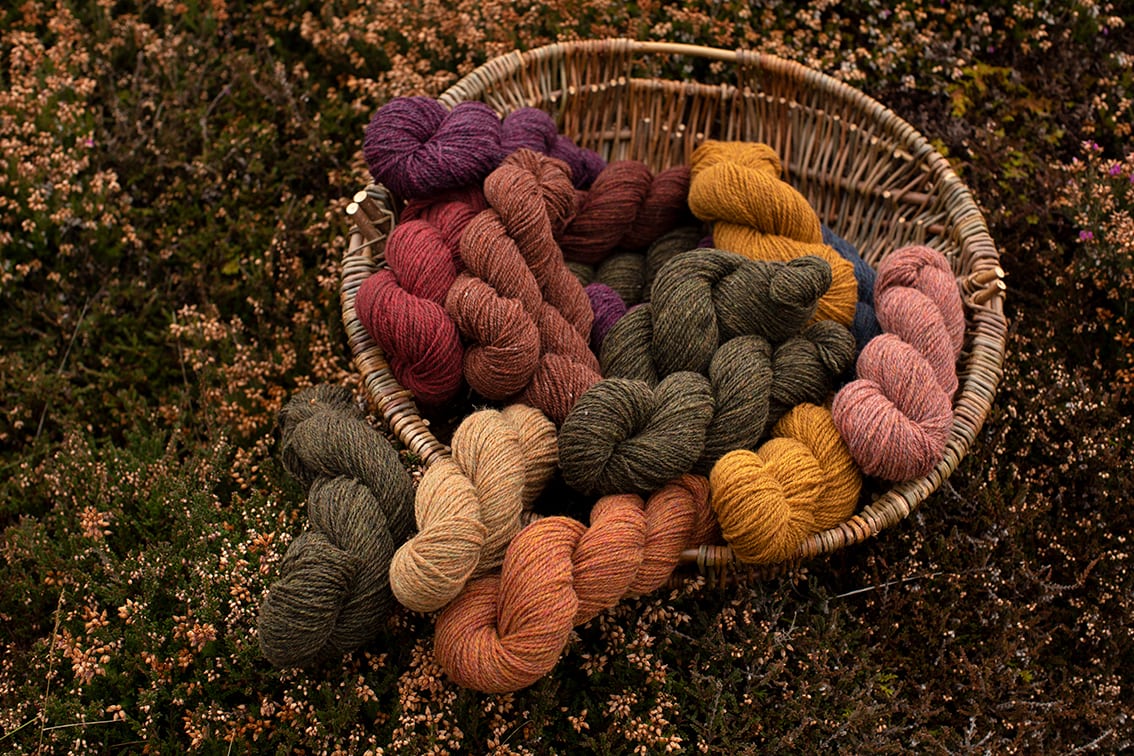
My interest in everything from rock pools to marram grass has influenced my perception of colour, but it is only now that I realise how important the sea and shoreline has been for my awareness of the subtleties of texture. It has been a pleasure to stravaig the shore for the purpose of developing the Hebridean yarn range. The shades that follow all focus on an aspect of the sea and shoreline that I find significant.


Pebble Beach
Pebble Beach

PEBBLE BEACH

Sea & ShorelineThe rocks of the Outer Hebrides mainly consist of gneisses, granites and schists of Precambrian origin. Lewisian is the term that geologists bestow on these particular examples. Our outwardly simple local geology has many complexities that I try to come to grips with, but I am a long way from becoming even a competent amateur. The designer in me takes over and I tend to admire the colours and textures.

Apart from a few small areas of shale in the uninhabited Shiant Isles, there is only one formation of sedimentary rock in the whole of the Outer Hebrides, and it is right beneath my house. It is a conglomerate known as the Stornoway Formation, covering only forty square miles or so, and consisting of smooth, round pebbles of gneiss in a sandstone matrix. These Stornoway beds are in the form of a series of alluvial fans that were laid down in the Permian and Triassic eras, and my imagination tends to overload when considering the rivers that must have deposited them. They must have been mighty.

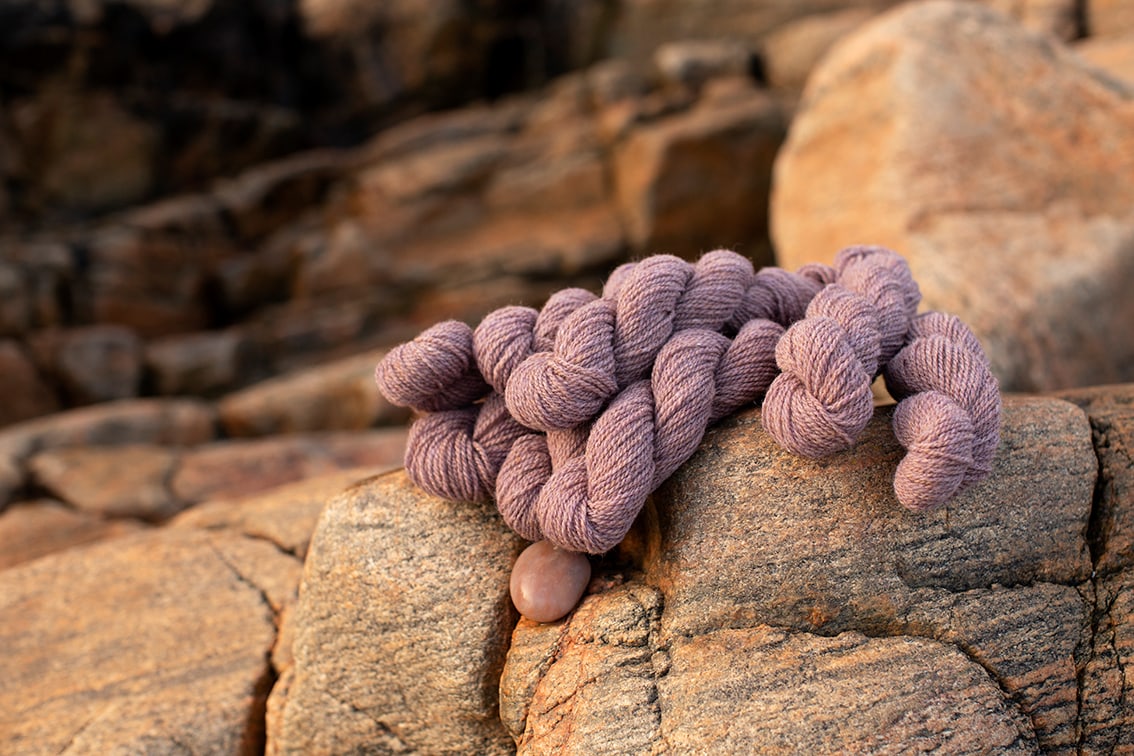
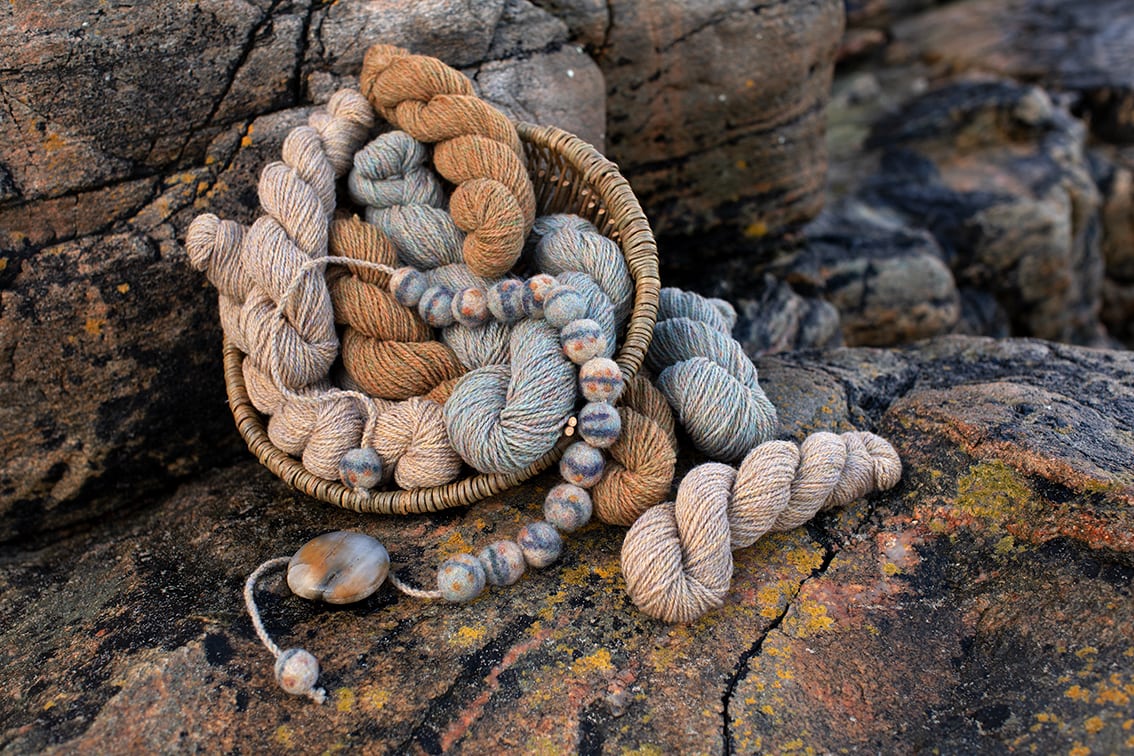
Where my croft meets the sea there are low cliffs of this conglomerate, about twenty to forty feet high, so it is possible to view the beds in cross section. I prefer the term puddingstone to conglomerate, for a pudding is exactly what it resembles. The sandstone erodes faster than the gneiss pebbles, and at the very far end of my croft, at a point of land known as Gob Tanga, there is a cave with two mouths to it, and a spectacular pebble beach. From a distance this beach is a uniform blue-grey, but scramble down the cliff and there are more colours than you might care to count. Look closer still, and there are even more colours - in the form of countless pebbles, each one different. My favourites are what I call the Irish Queen pebbles. Red and green should never be seen, except on an Irish Queen. The green is actually called epidote and the red streaks are haematite. There are many other colours however, including "eggs" of pure white quartz; flecks of different seaweeds, and the occasional bright piece of sea-smoothed glass.

Our Pebble Beach shade is a blend of over thirty colours, warranted different every time you blink.


Spindrift
Spindrift

SPINDRIFT

The spindrift as the waves comb across the beach is an enduring symbol of the shoreline. My favourite spindrift occurs in bad weather. I live on an angle in a bay where a broad beach meets the cliffs. The beach faces east; the cliffs face south. When a really powerful, surging tide is on the rise and there is also a fierce west wind, then the two forces meet head on to give an effect that is truly Wagnerian: you can almost see the Valkyrie riding the white horses, set against a background of deep storm blue. You may not in real life see the flecks of sand and seaweed that flies in with the spray, but I know they are there, so we have blended them in with our version of the colour.


Sea Ivory
Sea Ivory

SEA IVORY

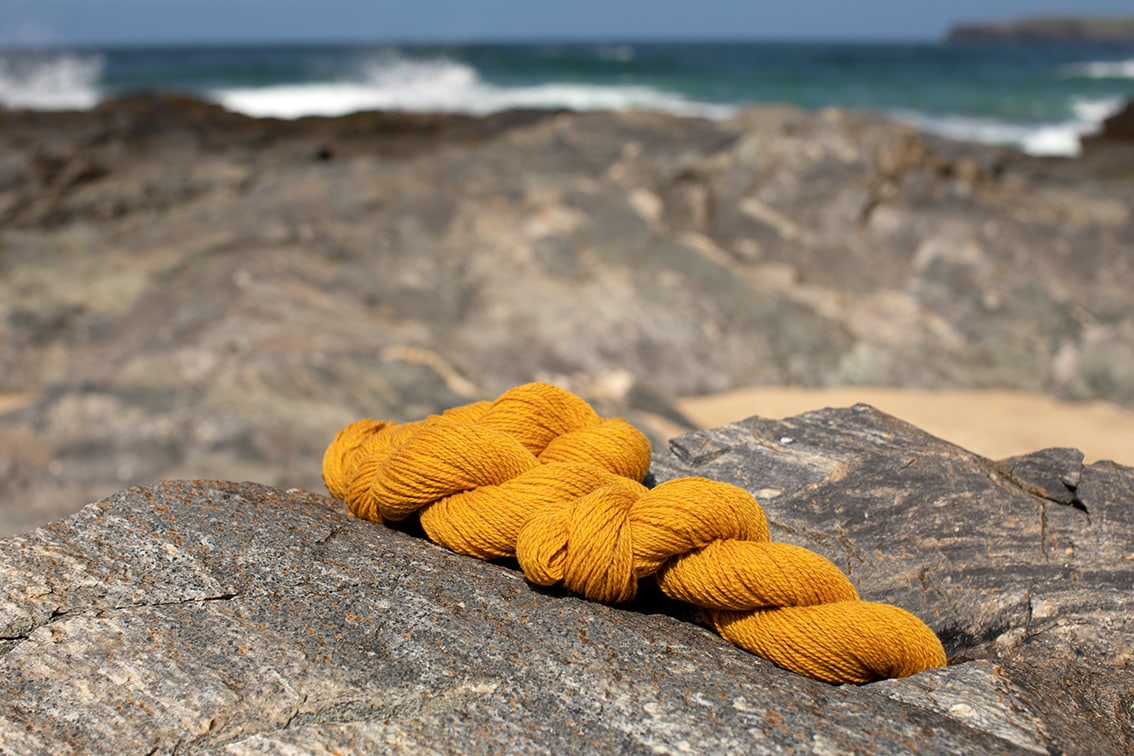
The botanical name for this seaweed is ramalina scopulorum, but I prefer its Gaelic name, Fiasag nan Creag, which translates as "beard of the rocks". It only grows on rocks which are regularly clear of the water, and takes its name from the sheen of its green strands. This silvery green is extremely subtle and well deserves its appellation, ivory of the sea.

Sea Ivory can be used as a dye plant to give an orange-brown, but the weed must be harvested in late spring. Results at other times of the year are variable to non-existent.

We have not been concerned with the dye results however. Our aim has been to capture the subtlety of the silver green weed itself, together with its sheen.


Selkie
Selkie

SELKIE

SealSelkie is a common Scottish word for a seal of any kind. I am very fond of the animals, from the fat harbour seals of Stornoway to the sleeker variety that spend summer on the rocks at the end of my croft. They are the best of neighbours - interested but not too pushy. My croft runs down to low cliffs, and when I take a walk along them, two or three seals will usually put their heads up and follow me. If I call to them, then several more will come. In season the males will let out long, drifting cries which sound eerie - or worse - if you do not know what is making the noise.

The most common Scottish seal legend - of which different variations exist - is that the Selkie can turn into women and come on shore to dance. The Hebridean version relates that a famous bard and harpist from South Uist was the son of such a sand-dancing Selkie. The bard's father was a fisherman who had been captivated by the beauty of the seal-woman, and hid her sealskin so she could not return to the waves. The fisherman forced her to be his wife and she gave birth to the bard, to whom she taught songs and strange music. The young bard found his mother's sealskin hidden in his father's barn and gave it back to his beloved mother. She returned to the sea, and the bard was often seen talking to seals thereafter, and his music and tales were ever the finest heard.

I wanted a blend that was dark like wet sealskin, but with the glints of colour that come through when the sun strikes their backs. In short, I wanted something that would suit a beautiful seal-woman, hence Selkie.


Driftwood
Driftwood

DRIFTWOOD

If you spend a lot of time stravaiging the shoreline, you will naturally encounter a lot of driftwood. This simple term encompasses quite a range of ocean timber, from small planks to enormous tree trunks which must have crossed the Atlantic from America. By the time they land they have become studded with pebbles and bored by the aquatic equivalent of woodworm.

There is hardly any native timber in the Outer Hebrides, and so the larger pieces of driftwood were of vital importance when the people of the islands had precious little. Their blackhouses were roofed with turf and thatch, laid upon whatever spars of wood that they could gather together. Even now times are immeasurably better, the old gathering instinct lives on in some Hebrideans. In fact, some of them are quite obsessive about it. The standard convention is that if a piece of driftwood is in the tidal zone then it is yours if you want it. If it is up beyond the obvious high tide mark, then someone has dragged it there and has claimed it, so leave it alone. I know of one quaint character on the west side who scans the beach daily and hauls up any large logs with his tractor before anyone else can claim them. Over the years he has accumulated enough to build a forthright stockade, which I am hoping he will one day, but as yet it still lies there forlornly, like a lot of giant knitting needles all scattered about. I shouldn't mock, for I understand the motivation. When I come across a really good log of unclaimed driftwood, I really do think that the ghosts of my ancestors start to whisper in my ear, for I start to think things like… now that is really useful. You can't just leave a good piece of wood like that lying there. Take it home and do something with it. Sanity intervenes when I realise that it must weigh half a ton, so I give it a pat and walk on.

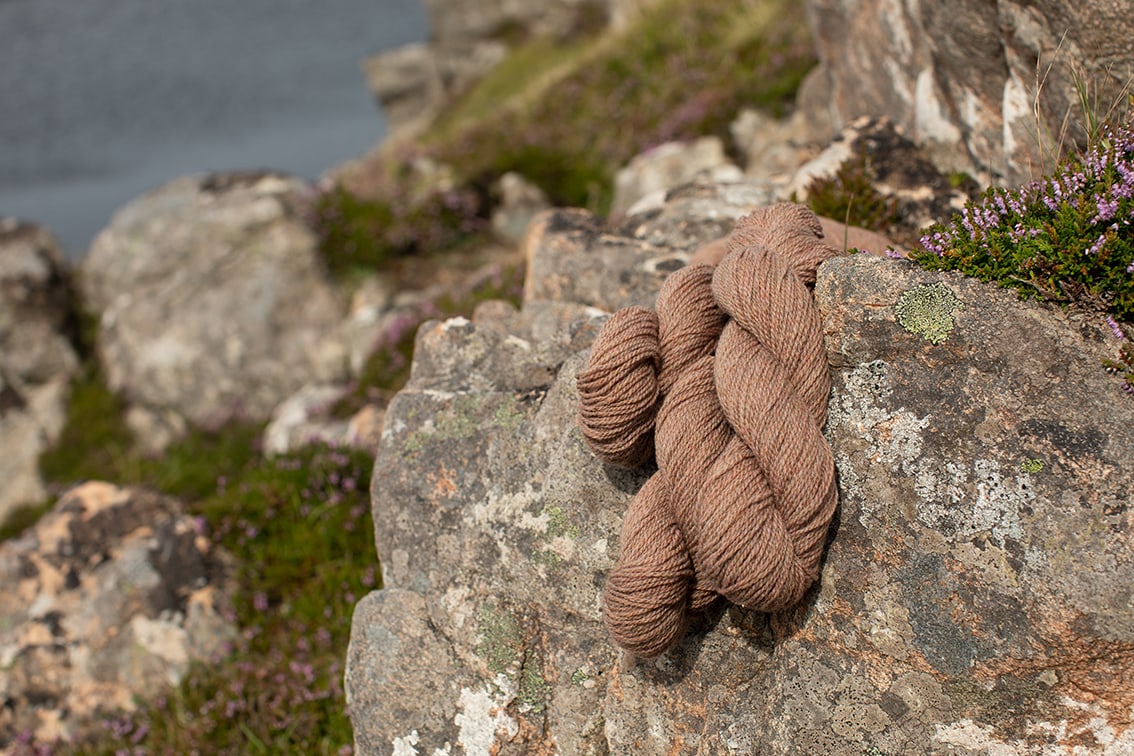
What I really love about driftwood is the way that the sea has bleached away most of the colour, but a certain luminosity remains. That is what I have tried to capture with this shade. The tiny touches of orange and rosy mauve are the lichens that grow when the driftwood has been beached for a while.


Limpet
Limpet

LIMPET

The first mesolithic food gatherers stumbled from their dug-out canoes onto Hebridean shores while Britain was still linked by land to continental Europe. The sea level was in the process of rising following the last great ice age. I struggle to imagine these people of ten thousand years ago. Few of them made it to thirty years of age, but did they look like old men and women by that time? I certainly have no idea. Some of their tools have been found: fish hooks made of bone; digging tools made of antler; primitive stone hammers. Their rubbish has remained also, in special dumps or middens. What does it consist of? Limpet shells mainly - thousands of them, along with other crustacea. They must have spent a lot of time eating them, for it takes about seventy limpets to equal the food value of the average helping of meat. It was to be another 2000 years before the first farmers arrived with their animals and seeds. That is a long time for shellfish to be the main item on the menu.

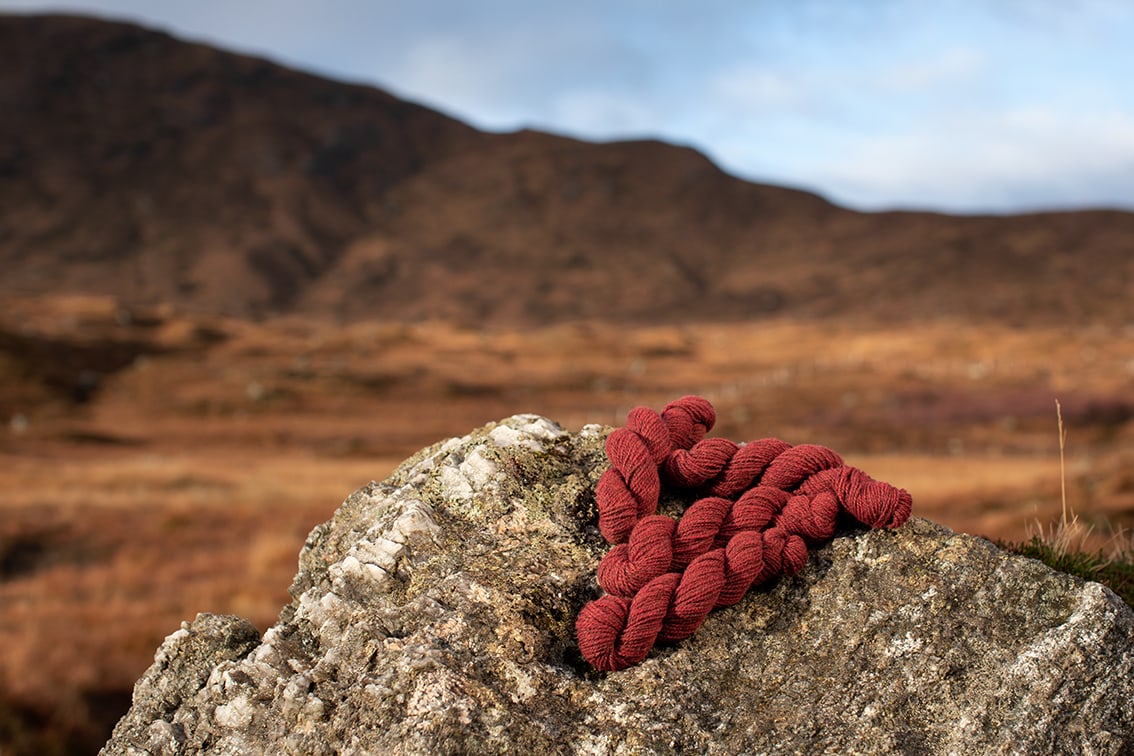
When we went to the mill to discuss this shade, we took along a limpet shell, a mussel shell and a crab's leg, all from Gress Beach, which I can see from my window as I write this. We were aiming for a rich, lustrous shade with a deep pearly sheen, and that is what I think we have captured in this blend.


Carrageen
Carrageen

Dulse
Dulse

CARRAGEEN & DULSE

On days when I rail at our wet and unpredictable climate, I have to remember the positive side. The Hebrides has some of the best beaches in the world, and if it wasn't for the climate, our clear, unspoiled stretches of sand would be very different indeed. There are beaches that I choose for different moods, but if I had to pick a favourite - the beach that has everything - then it would have to be Seilebost (pronounced shee-la-bost) on the west side of Harris. It has high dunes with marram grass; machair with summer flowers; fringing mountains of ancient granite; a sea of supernatural blue, and a sweep of pale sand that is dotted with tiny shells of many colours, spread open like butterflies. I have therefore based two of our Sea & Shoreline colours from a recent walk along this beach.

I picked up two small clumps of dried seaweed, both of which were tangled up with fragments of shell, sparkling sand grains, and flecks of other types of weed. Carrageen is the darker of the two colours - a green with tints of russet and mauve. Dulse is the paler version - a lighter green with a myriad of other shades to represent the fragments and streaks.

Both Dulse and Carrageen are edible. The most common way to eat them here was to boil them and allow them to set into a jelly. Dulse is also reputed to give brown dye, but I have not tried it yet as I have not yet exhausted the possibilities of Crotal.

Mara
Mara

MARA

SunsetMara is simply the Gaelic word for sea. I wanted a definitive sea colour for our range, and a very particular one at that. I wanted the bluest sea, as when the tide is coming in during warm weather; when it is getting late but there is still a lot of light about. This blend captures the mood to perfection.

Mara is a short but beautiful name and visitors sometimes wonder why there are no Hebridean girls so called. The answer is simple - how many girls in English-speaking countries do you know who are called Sea? I do happen to agree that there is music in the two short syllables, and so here is a tale about a Hebridean girl called Mara. The girl on whom the story is based probably wasn't called Mara, but her name is unrecorded as far as I know, so I think I have licence to call her what I like.

Mara Macleod was a Siarach, which means she came from the west side of the island. She was born in the village of Garenin, near Carloway on the Atlantic coast of Lewis, in 1791. Mara was a rarity in her time as she was an only child. If a Lewis woman died in childbirth or for any other reason, then her husband would usually marry again soon after and other children would duly arrive. It was rare indeed for a woman to deliver a healthy child; be in perfect health herself, and not fall pregnant again. In fact it was so rare that no-one could understand it, least of all Mara's parents.

So Mara grew up without brothers or sisters, although she had an army of cousins to play with. She was not regarded as an especially beautiful child, for in that time and that place, it was thought advantageous for a female to have rosy cheeks and a bit of flesh on her bones. Mara was a pale-faced, spindle-shanked will o' the wisp who looked as if the wind could pick her up and carry her away. Also, her thick black hair was wild and rampant, unlike the glossy tresses that were so much admired. Her eyes were serene and grey, with flecks like the coat of a seal pup, and so they also fell short of the Hebridean ideal. Her parents loved her and being their only child, she was the light of their lives. She grew up dutiful to both of them, for not only did she carry water and fuel, she also learned to spin and help with the animals, of which there were a dozen sheep; two cows with calves at foot, and a share in a horse. It was laughingly said that Mara's father had no need of a dog, for she was exceptionally fleet of foot, and could run over stones and bogs as if her feet were not actually touching the ground. Her father laughed with the rest of them, but was proud of his daughter's talent. He diligently worked his croft and although poor, the little family did not go hungry. He never said it out loud, but he did realise that having just one child did have certain advantages.

By the time Mara was eleven years old, she had accompanied her father to town on several occasions for the purpose of selling beasts. It was no surprise therefore that one November day she set out with him for Stornoway, driving a fine bullock before them. There was no road at that time and their way took them across the moor by the route that all west side drovers took. The landmarks were well-known and easy to follow, apart from one featureless tract of bog and heather that lay more or less at the middle of the journey. The day was crisp with a frost that eased their progress, for it made the moor less inclined to be boggy. All went well in the town; a good price was got for the beast, and the father indulged them both in a simple but good meal in a tavern. He fell in with neighbours from the village and several drams were taken. It was six o' clock when they started home, which at that time of year meant it had been good and dark for two hours. There was no moon, but it didn't matter for they were in the company of their fellow villagers and the mood was convivial.

The party was just a few miles out, over the River of the Willow Glen and well past the eminence known as Mary's Hill, when Mara's father realised he had left behind the pack containing the items he had been charged by his wife to purchase in Stornoway. He committed his child to the care of his neighbours and resolved to hurry back to retrieve it, saying he would easily overtake them again before reaching Carloway. They had no reason to doubt his word for he was a man in the prime of fitness.

The first flakes of snow were falling as Mara's father re-crossed the River of the Willow Glen on his way out of town for the second time, his pack securely tied across his shoulders. He proceeded as only a seasoned moorwalker could, going at exactly the right pace to ensure the greatest speed without having to pause for breath. The snow was falling fast and beginning to settle, so he kept up his pace, anxious to be clear of the worst part of the moor before the weather closed in hard. Despite the lack of moon he could see his way by starlight through gaps in the transient clouds. He caught up with the company at the outcrop of rock known as Cleitichean Bheag, where the trail divided either for Carloway to the north or Breasclete to the south. He found them all in good spirits, partly because the flagon had been passed a few times and partly because they were now on the home stretch. What he did not find was his daughter.

It was a distracted and anxious father who flew back across the moor towards the town, shouting Mara's name as loud as he could. The company were mystified. The girl had been with them no more than half an hour previous, walking well as was her habit, and in no sign of distress. How she had come to be separated was utterly beyond their knowledge. Two of them followed Mara's father back through snow that was falling ever rapidly. The hour was late when all three reached the town, exhausted and frantic, for not a trace of the girl had been found.

Many were the willing searchers who went forth from both Stornoway and Carloway next day. The snow had ceased but it covered the moor and made it difficult to see the way. It did give the advantage of maybe showing footprints that Mara might have left, but there was not the slightest sign. The search continued all day; then the next, and the next. The wind backed to the south and a gale blew up which wiped away the snow before it, leaving a moor that sucked at the feet and made fast progress impossible. The search parties roamed as best they could, systematically quartering the land from the trail outwards, but still finding nothing.

The effort fell away after three weeks, for common sense dictated that no-one could survive without shelter out on the moor in what was now December. Some continued to aid the haggard parents, who were obviously in no mood to give up. Both father and mother searched together, doggedly putting one foot before the other, for movement became vital to their very being. If they ceased to move then the black despair would grip until they were in danger of losing their reason. Onward they searched, tramping glens and low places deep in the moor that other searchers might have missed. They searched the clusters of shielings that folk went to in summer but which were now empty. They looked under the overhanging heather of the streambanks, and they stared out over the inky surface of innumerable lochs. At last, on the summit of the highest hill around and known as Beinn Mholach, they stood and hopelessly called out their daughter's name to grey, featureless skies. It was here that a neighbour heard them and came running hard to give them the news that Mara was alive.

She had been found on the seashore near a village called Barvas, some miles northwards up the coast from Carloway. She had been found by a man with a dog, and he had found her unable to walk. She was lying on her face near the surf, licking the salt from sea pebbles. Of how she had managed to get there, she had no recollection whatsoever. All she could say was - the sound of the waves had led her there.

Mara was tended carefully in the nearest house. She was fed little and often, and was visited by the physician from Stornoway who came without request or fee. Gradually her strength recovered and she showed no lasting injury, but still she could give no account of her weeks out on the moor. The sound of the sea remained her only memory. This remarkable case of preservation caused interest throughout everyone on the island, high and low alike. Lady Seaforth, wife of the island's proprietor, took a special interest in the girl and visited her often. In fact, when Mara was fully restored to health, Lady Seaforth took the unprecedented step of inviting the girl - the daughter of a poor tenant crofter - up to the grand Lodge in Stornoway where she was plied with all manner of unfamiliar delicacies and sweetmeats. The other remarkable event was that Mara's mother fell pregnant the month after her child was restored.

That is more or less the end of the tale. When she turned thirteen, Mara was offered employment in service at Seaforth Lodge, which she accepted and where apparently she was happy. How long she remained in this employment I do not know, for I can find no further record of her, although I will continue to look. All I can add is that for many years after Mara was lost and found, travellers on the moor between the west side and Stornoway would frequently stop about half way and listen for the sound of the sea. Grown men could never hear it, and women but rarely. Children on the other had, always claimed it could be plainly heard - if they listened hard enough - which seems to be the case with many things in this world.

HOME | NEEDLEPOINT | ABOUT | DESIGNS | SUPPORT | DRIFTNET | ORDERING | COLOUR STORIES

Copyright © 2001-2008 Virtual Yarns. Site by ReefNet.