back Designs Virtual Yarns

Summer Isle
Summer Isle

Summer IsleIn his diary of a marine expedition, The Log From The Sea Of Cortez, John Steinbeck pointed out a salient characteristic of most fishermen. He was on a chartered fishing vessel heading for the sea of the title, and he was listening to the skipper talking on the radio to other boats around and about. The talk was of who was catching what, and where. It was 1940, Hitler had overrun France, and the invasion of Britain was imminent, but neither Steinbeck nor the crew knew it. They did however know the catch of every boat within a radius of several hundred miles. Steinbeck explains it beautifully. It was simply a directional thing; a man has only so much.

Coming not just from a family, but a community of fishermen, I can testify to the truth of his observation. Fishermen tend not to mention the magic of dawn rising over the Minch or the proud surge of the vessel as the nets are shot. Their talk is usually of prices and diesels and the rank stupidity of governments. Any magic there may be comes from the place names that crop up casually in conversation. Oh yes… such-and-such is to starboard as you sail into Lochinver. So-and-so is on the port beam heading south down the Sound of Sleat. It was overhearing such conversations that I first heard of the Summer Isles. Their mention made my eight-year-old ears stand up. The Summer Isles! Where are they? What are they? My imagination was fired by these islands of perpetual summer, and I longed to visit them.

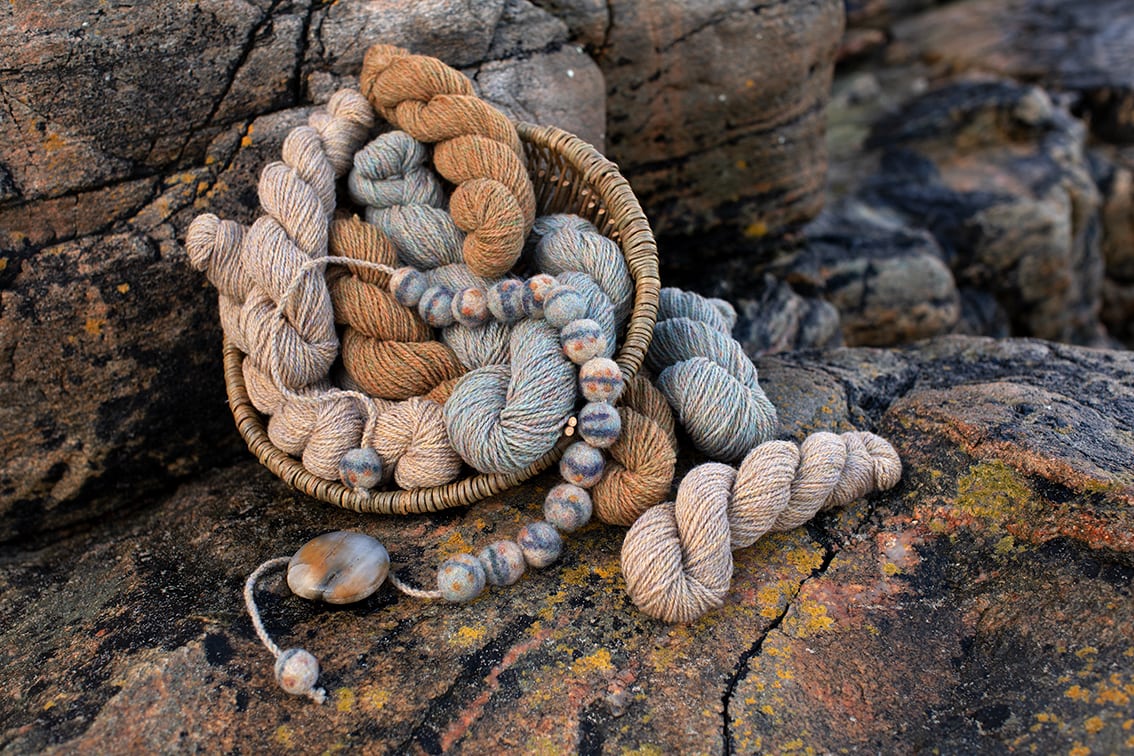
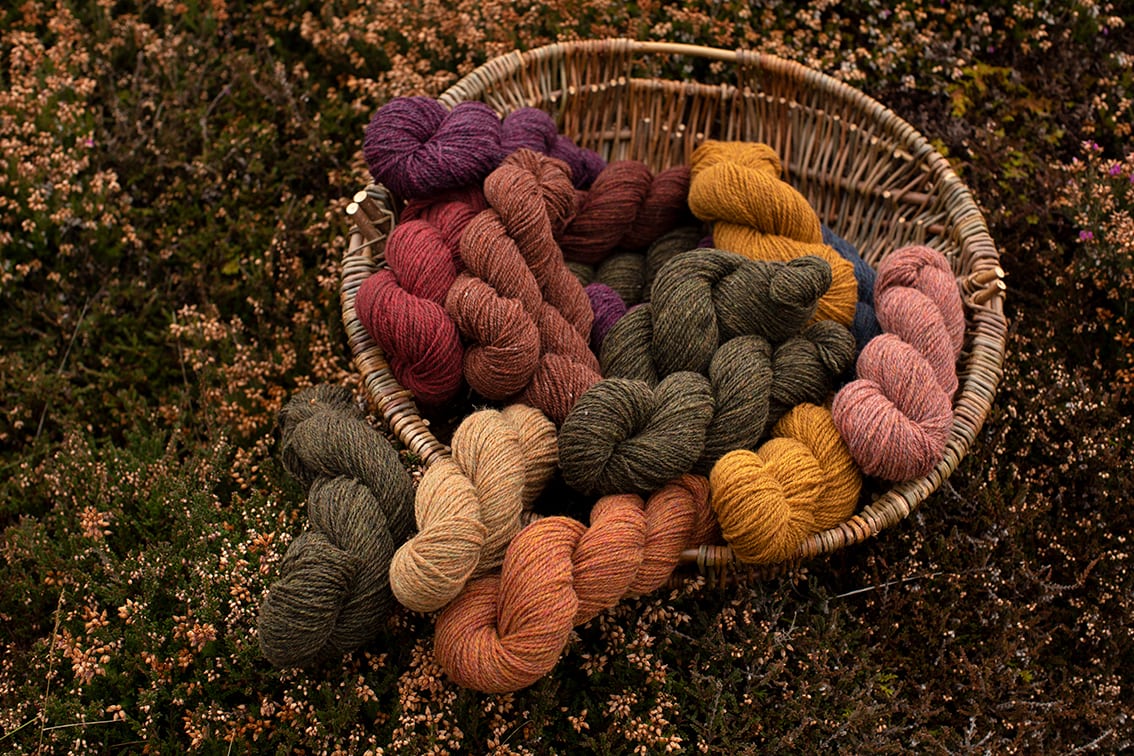
I never have landed on them, but I have passed them many times. The ferry from Stornoway sails by them as it makes landfall on the mainland. They are at the mouth of Loch Broom on the run-in to the opposite ferry port of Ullapool, and they are a welcome sign that the three hour crossing is almost over. The largest of them are called Tannara Mhòr and Tannara Bheag. Adult truth is always more prosaic than childhood dreams, and the Summer Isles are small and uninhabited. The winter rain and wind hits them just as hard as everywhere else in the Highlands. For me however, they have not lost the childhood connotations that they once held. High summer in Lewis, when it never gets really dark, is my favourite season. The light on land and water brings out different shades to the other times of year. I wanted our Hebridean range to include breezy, clear colours that evoke childhood memories of endless summer days, and Summer Isle seemed the perfect name for them.


Witchflower
Witchflower

WITCHFLOWER

WitchflowerIt is well-known that young women of the Highlands & Islands were constantly changing - or being changed - into swans, seals, hares and what have you, which frequently gave rise to them being shot, or some such tragedy. Believe that and you will believe anything - or maybe not, for as a child I would believe my bedtime stories for the duration of the telling. Here is such a temporarily believable tale from the south of Harris.

Long ago, on the rocky east coast of Harris, there lived a witch or what some would call a ban sith (pronounced ben-shee), or fairy woman. The magic of this witch was entirely for the good, which means it largely passed unnoticed, for while the folk of those times were all too quick to put adversity down to witchcraft, they would seldom realise that good fortune could be due to a similar cause. For example, the people of this rocky area, which was known as The Bays, had been "chased out" from their villages on the fair, sandy west coast with its fertile machair soil, for the absentee landlord of Harris wished to lease the best lands out to a wealthy mainland farmer for a greatly increased rent. When they arrived in The Bays the people despaired, for there were massive rocks everywhere, and nowhere was there a piece of tillable land larger than a tabletop. The witch, who had lived in The Bays for several centuries although she appeared no more than thirty years of age, placed spells of fertility on these tiny pockets of soil and made sure that they could produce enough oats to prevent starvation. She also placed the opposite of the evil eye upon their beasts so that milk and wool were always in plenty.

The eyes of this witch looked far from evil anyway, for they were a shade of blue that is only found in Tir Nan Og, or fairyland. Her plaids, which she spun and wove from her own sheep, were of strange colours also, for she knew of every plant that would yield a dye, and knew every rocky mountain crevice where the rarest plants grew. Wearing such plaids she could pass unseen beneath the very noses of the new arrivals, and often she would place spells of protection on the keels of their boats when they were upturned for the sabbath. Thus, their boats never struck rock or foundered in adverse seas.

Such constant care and vigilance took its toll on the witch, and she began to grow tired. Every now and then she would have to sleep long and deeply.

The new settlers had no notion of the work being done on their behalf, and simply thought that fortune had smiled on them. The one thing "fortune" could not provide was land deep enough for them to bury their dead, for there was a limit to the witch's powers and she could not move the very rocks beneath her feet. Nor could she prevent the lives of others from running their natural allotted span, and soon burials did indeed have to take place. The villagers sent a deputation to plead with the Factor, as the landlord's business representative was called. He treated them as he always did - with utmost disdain - but allowed them to continue using their old ancestral graveyard back over on the west side. In order to reach it however, the coffin had to be carried up from The Bays, over a rocky bealach, or saddle between two mountains, overlooked by a sheer crag called Creag an Eòin, or Crag of the Bird. The funeral procession had to be well fortified with drams in order to make the ascent. The coffin had to change hands many times and many stops were made. At each resting place, a cairn of loose stones was built, and these cairns would be added to on future processions (today, they are higher than a man). Once the pass was reached however, the journey was all downhill, and the hearts of the displaced villagers would lighten as they caught sight of the first flash of Atlantic aquamarine behind their old fertile machair lands. Then they would remember the extent of their loss and their tears would flow.

Because of the witch however, their tears did not flow as often as they might. At that time, there was a common fever of the new-born that was called the Five Night Sickness, for it peaked on the fifth night and no infant ever recovered from it. There were no physicians willing to treat the people of The Bays, and even if they had been, they would have been baffled by the sickness. The witch kept extra vigilance at the time of a woman's confinement, and by use of herbal charms called lusragan, she kept the Five Night Sickness away from their doors. This left her especially exhausted, and if there were several babies born one after the other, she was sometimes in a deep sleep when needed. Thus, infants were sometimes lost, but nowhere near as many as might have been. On such occasions, the witch would follow the procession up to the pass, hidden in her plaids of many strange colours. Her tears would flow along with those of the settlers, for she would weep with them and weep for her own failure. Wherever her tears landed, a small flower would grow that bloomed the same colour as her eyes. It grew thickest near to where the resting-place cairns were built, for here the witch would stand off to one side and weep silently. There were those perceptive enough to recognise the flowers as a sign of good. Such far-sighted folk would occasionally catch glimpses of the witch's strange eyes and shifting plaid as she moved about the mountainsides. It was these folk who named the blue-flowered plant lus nam ban sith, or Witchflower. The devil seethed with anger, and being fearful that the plant may have healing properties, tried to destroy it by taking bites out of the roots, which gave rise to its other name of Devil's Bit Scabious. In those parts of Gaeldom that did not have such a positive view of witchcraft, the term lus nam ban sith was applied to Foxglove, or digitalis. However, I think the good variant deserves a place on my mythical Summer Isle, so here it is… a spectacular blend of intense blues called Witchflower.


Machair
Machair

MACHAIR

MachairWhat is machair? Every Gael knows the answer to that although there is some dispute amongst biologists and ecologists, so I quote the definition given by the British conservation body, the Joint Nature Conservation Committee in 1995.

Gently sloping coastal plains formed by wind-blown calcareous shell-sand, which incorporates a mosaic of species-rich grassland, fens and lochs, with dunes towards the sea and blackland (a mixture of peat and sand) further inland. All these individual elements are crucial parts of the machair system. The grassland has traditionally been maintained by low intensity agriculture. In Europe this habitat occurs only in Scotland and Ireland.

From this definition it can be seen that while machair is a coastal grassland, not all coastal grassland is machair. A degree of shell sand is a pre-requisite; then a rare balance of enough wind to blow the sand when dry, but enough moisture to allow blown sand to be deposited. Then there must be exactly the right amount of light, managed grazing at the right times of year. In fact, it is a geo and bio-miracle that we have any at all, and between the depredations of overgrazing and 4x4 traffic, we might not have it for very long.

Those wishing to know the full details of how machair systems are formed should seek out The Outer Hebrides: the shaping of the islands by Stewart Angus, The White Horse Press, 1997, ISBN 1-874267-33-2. This is an academic text, but well-written and highly readable.

Those who simply want to know what they look like, should know that in high summer the machair explodes into banks of colour: Monet-by-the-sea? The explosion of floral life is rampant but delicate. Bird's Foot Trefoil, Clover, Daisy, Eyebright, Lady's Bedstraw, Red Fescue, Ribwort Plantain, Yarrow. This poetic litany names some of the machair flowers that bloom in summer - a delicate profusion set against a unique, tranquil green. We have tried to capture this effect in our yarn, and I am confident that we have succeeded.


Sea Ivory
Whin

WHIN

The shrub called Gorse or Whin is not the most attractive of botanic specimens, but it is very tough and spiny. When large enough is makes a hedge that no beast can penetrate, let alone human. Its toughness is so legendary that it has been adopted as a badge by no less than three Highland clans - the Logans, Maclennans and Sinclairs. Its cousins, the Genistas or Brooms have also had a long emblematic history, for they gave their name to the Plantagenet (Planta Genista) dynasty of English kings.

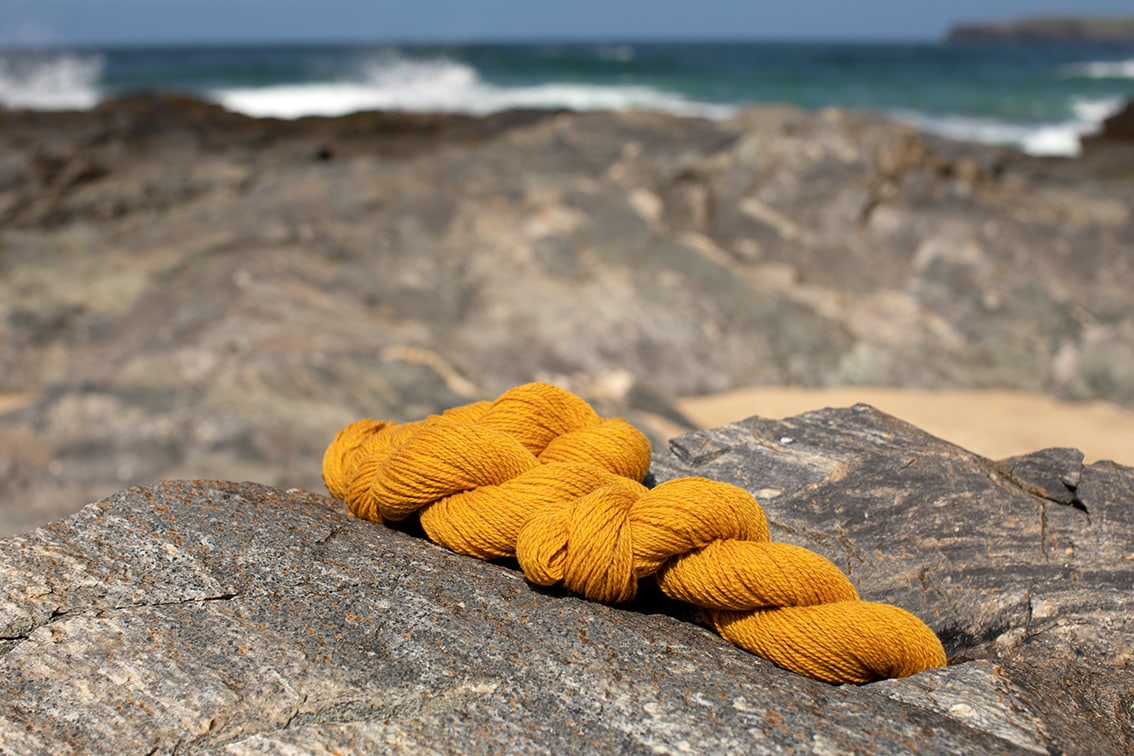
Whin stands mainly by roadsides in the Hebrides, and no-one really pays much attention to it - until May that is, for that is when it flowers and becomes spectacular, being covered in a profusion of flowers of a rich, golden yellow. If you collect these flowers in season, you can obtain a beautiful yellow or gold colour, according to how you mordant the yarn. If you care to risk the spines, then the leaves and chopped bark can also be used to obtain an interesting green, but the process is quite long. The leaves of Whin are said to have antiseptic qualities as a wound dressing, but you will probably be in need of it after harvesting them - those spines again.

I have used the gorgeous spring colour as the model for our shade - a particularly rich blend of yellows and golds.


Poppy
Poppy

POPPY

PoppyIn the 18th Century, a young Highlander by the name of Murdoch Macleod qualified as a surgeon and apothecary, and emigrated to the American colonies. There he set up in business as an apothecary in a shop in Cross Creek, North Carolina. When the War of Independence broke out he joined the British army as a surgeon and was taken prisoner. On release he took ship back to Scotland and settled down as a local doctor in North Uist in the Outer Hebrides. Of Murdoch's five sons, four also went into medicine. One of them, Alexander born 1788, was to become a Hebridean legend as a physician and master of herbal lore. He became known as Dotair Bàn, which translates as the Fair (as in blonde) Doctor.

The Dotair Bàn used a combination of local plants and sympathetic psychology to treat the patients in his practice. One of his grandsons, yet another Dr M Macleod wrote a memoir of his grandfather in the Caledonian Medical Journal. He commented:

Many of the indigenous herbs have medicinal value - e.g. the gentians, the potentillas, the trefoils, the poppies - and infusions, tinctures and decoctions of them are, as far as they go, as useful as those manufactured from their tropical congeners which are richer in alkaloids.

Sadly, the Dotair Bàn died in 1854 from a fall down a sixty-foot drop while returning from an urgent night-time call to treat the wife of a shepherd. He lost his way in the dark in trackless terrain. It took two days to find his body, and there was great local relief when it was obvious that he must have died instantly. I briefly tell his tale partly because his memory deserves it, and partly because the poppy was amongst his materia medica. One of its uses would have been as a sleeping draught, for the Gaelic for poppy is lus a' chadail - herb of slumber.

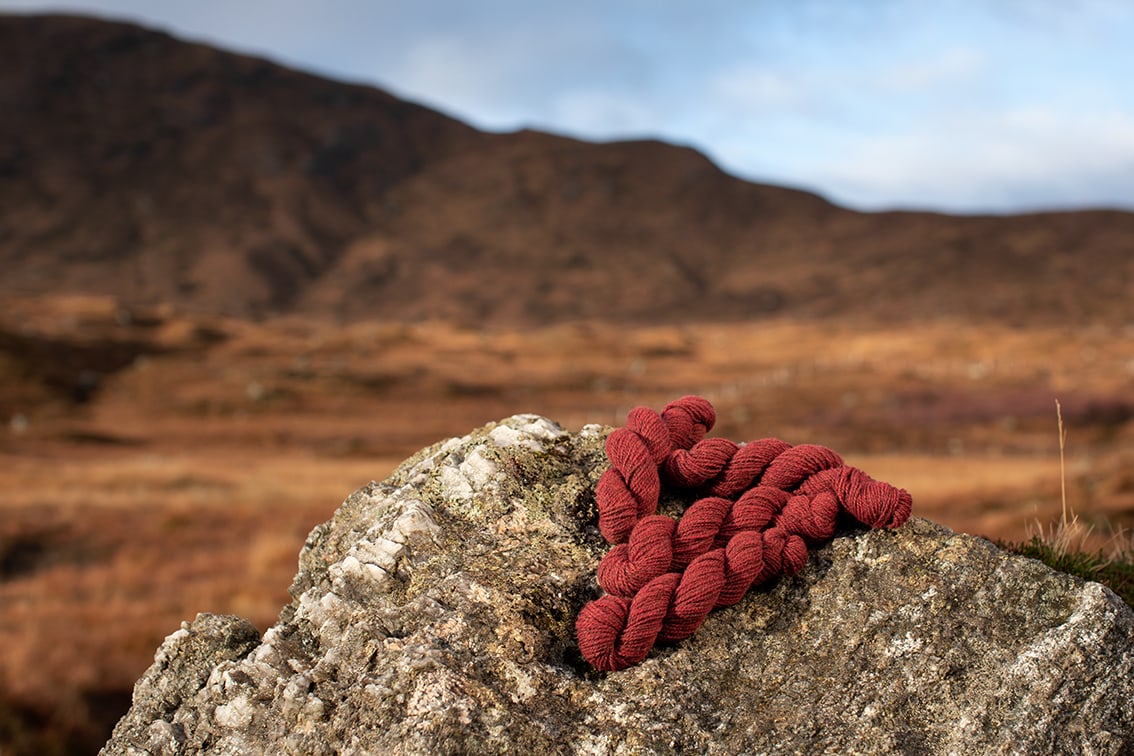
Various poppies - chiefly common; long smooth-headed and opium - grow in Hebridean grasslands and cultivated fields in summer. I particularly like their flashes of pure red amongst the green of potato shaws. They seem to me like pieces of scarlet muslin, and they form the basis of this worthy addition to our Hebridean pallette.


Red Rattle
Red Rattle

RED RATTLE

Pedicularis Palustris, otherwise known as Red Rattle, is my "someday" plant. Someday I will see if it has any virtue for dyeing purposes. None are mentioned in any of the old sources, but it has a russet tinge to its leaves and stem, and flowers of such a beautiful red that I am certain there must be dye in there somewhere. I suppose that one reason I have been rather lax over Red Rattle is the fact that it is so common. It is ever the case that you ignore what is right before your eyes. For the present, I have used it as a model for this blend of warm reds that definitely belongs on Summer Isle.


Strabhann
Strabhann

STRABHANN

CURRENTLY ONLY AVAILABLE IN HEBRIDEAN 2PLY

When a clear, unpolluted sea comes in over such a pure, pale beach, then the intense turquoise blue that results is quite startling, so we could not fail to include it in our range. One of my favourite beaches where this effect occurs is near a glen called Strabhann, so that is what I have called this shade. Pronounce the word stra-van, with the stress on the last syllable.

There happens to be a beautiful Gaelic song about an attempted courtship in a glen called Strabhann, so for those who wish to do some more stravaigin, here are the words.

Latha dhomh 's mi nam aonar anns an òg-mhadainn thràth
dol tro ghleanntannan uaine mar fhear-fuadain gun stàth,
nuair a chunnaic mi a' ghruagach an taobh shuas dhìom a bha
's i ri nighe a cuid aodaich a-muigh air aodann Strabhann.

'S ann a smaoinich mi an uair sin dhol chun na gruagaich gun dàil
Is gu labhrainn-sa rithe gu sìobhalte blàth,
Tha còrr agus bliadhna on thòisich an gràdh,
saoil a ghaoil nam biodh tu deònach sinn gum pòsadh gun dàil.

Gu pòsadh, gu pòsadh ro òg tha mi an-dràst -
tha cainnt aig do sheòrsa gu fòirneartach ceàrr,
bhiodh m' athair 's mo mhàthair gam chàineadh gu bràth
a dhol a phòsadh do leithid, a fhleasgaich gun stàth.

Na bruidhinn mar sin rium a nighean an àigh
Chan eil fhios agad idir mar tha mise led gràdh
Ach tionndaidh 's bi deònach 's thoir dhomhsa do làmh
's siubhlaidh sinn fad ar saoghal a-muigh air aodan Strabhann.

The following translation is true to the spirit of the song, rather than the detail.

As early one morning I wandered alone,
Through deep glens of green and tall hills of grey stone,
I saw a fair maiden on slopes high above,
A year and a day my heart's only true love.

I climbed up to greet her with words warm and kind,
Sincerely and freely I told her my mind,
Four seasons have passed since my love first began,
Please marry me now in the glen of Strabhann.

I cannot yet marry, my years are too few.
My father and mother would think ill of you,
Pour scorn on your kind and the whole of your clan,
And a shadow would fall on the face of Strabhann.

Don't speak of the hate of your kith and your kin,
Good fortune and fate are for free souls to win,
So trust in your heart and take hold of my hand,
And let our love shine on the face of Strabhann.

This version of the song ends here, leaving the conclusion open to the imagination. There is another version that ends sadly.

Ach a nìonagan òga tha gun phòsadh 's gach àit,
na diùltaibh fir òga le mòrchuis no tàir,
Nach muladach dhomhsa bhith gun phòsadh gu bràth -
's fheudar fuireach nam aonar mach air aodann Strabhann.

So unmarried maidens where e'er you were born,
Refuse not your suitors with pride and with scorn,
As my love cruelly spurned both my heart and my hand,
And left me to grieve in the glen of Strabhann.


Clover
Clover

CLOVER

CloverWhen roads are upgraded in the Outer Hebrides, it is usually a case of replacing a single track road with a two-lane version. Sometimes the old road is simply widened, but more often than not the line of the road is changed and the new one charges straight through the landscape instead of meandering as in quieter times. This leaves sections of the old road stranded off in the moor, rather like ox-bow lakes in a river system. They lie unused and forgotten, dreaming their own dreams and keeping their own counsel. It is then that the grass and wildflowers show off their lust for life and the transitory nature of tarmac, for they start to reclaim the land back for nature. Clover is usually well to the fore. I like seeing its red and white clumps on little stretches of lost Hebridean highway.

The other spectacular place for clover is on the machair where it bursts out in a summer profusion of coloured clouds and drifts. We have chosen the red variety of clover for our Summer Isle colour. Its vitality reflects that of the plant itself.


Wild Orchid
Wild Orchid

WILD ORCHID

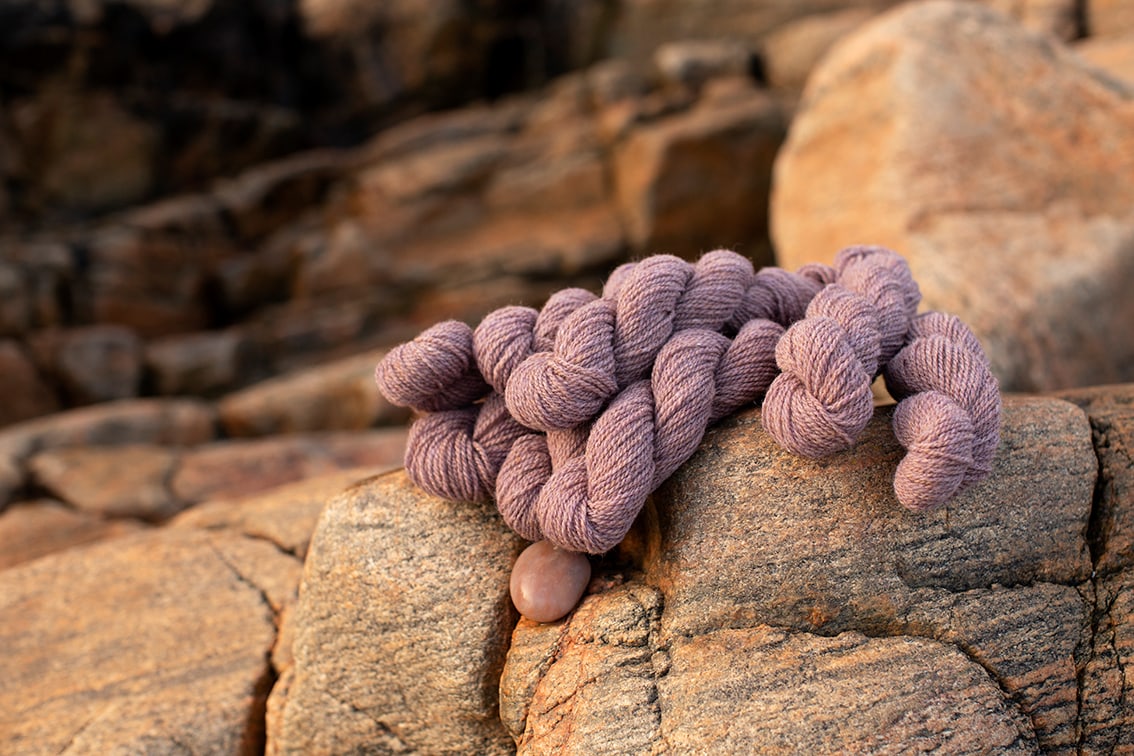
Orchids tend to be associated with a hot, steamy environment, so it surprises most people to discover there are varieties that grow on our northern peat moors. They are quite small, but get down to their level and you will see they are as exotic in appearance as anything from a jungle. There are various species and sub-species, making them quite difficult to positively identify. I am (almost) positive that the one that grows on my croft is Dactylorhiza Ericetorum. It is not common in Britain as a whole but grows quite profusely in the Outer Hebrides.

It flowers in May to July, and we have used its lilacs, violets and mauves as the model for our blend.


Summer Tide
Summer Tide

SUMMERTIDE

CURRENTLY ONLY AVAILABLE IN HEBRIDEAN 2PLY

LuskentyreThis blend is the result of my wish to capture the effect of the tide coming in over rocks at mid-day in high summer. The sea at this time is full of bright and lively blues, peppered with the glint of pebbles underneath. My favourite place to watch this happening is a cove called Geodh a' Chuibhrig near the village of Swordale in Lewis. It has a shingle beach of marvellous pebbles; a mysterious cave, and various massive rocks of different sizes and colours. There is one particular smooth black rock about twenty feet high, and it is from the top of this rock that I like to watch the summertide coming in. What follows is a story of absolutely no relevance whatsoever, apart from the fact that it has its denouement on this very beach near this black rock, so if you have no interest in tales of mutiny, murder and Spanish silver dollars, you had better skip.

You have heard of the Caine Mutiny? Well, this is the story of the Jane Mutiny. The Jane was a schooner-brig of Gibraltar. She could carry ninety tons and belonged to a Moses Levy who resided in that port. On May 19th, 1821, the Jane set sail for Bahia in Brazil under the command of an English captain by the name of Thomas Johnson. There were seven of a crew, plus another Englishman called Peter Heaman who served as mate, and a French cook called Francois Gautiez. Among a mixed cargo, the Jane carried 38,180 Spanish silver dollars packed in canvas bags. These bags were in turn packed in sawdust in eight stout casks, six of eighteen gallons, one of nine gallons and one of seven gallons. The distance from Gibraltar to Bahia is about 4000 miles, which allowed plenty of time for greed to rear its head.

It was Gautiez the cook who first fell for the lure of Spanish silver. He persuaded the mate Heaman to join him in a plot to steal the dollars and they set about trying to recruit others from the crew. One of them was an exceedingly honest man called Paterson, and he told them exactly what they could do with their scheme. Why he did not immediately call the captain and have the pair of renegades clapped in irons I really do not know, but his failure to do so was to cost him his life.

One night, Paterson was at the wheel with Heaman as officer of the watch. Heaman clubbed Paterson over the head with a musket while Gautiez sneaked into the captain's cabin and discharged a similar musket into him while he slept. Aided by an Italian called Dhura and a Maltese cabin boy, the conspirators dumped both bodies overboard, and then they locked the rest of the crew away in the forecastle. At this time they were five days west of the Canary Isles, and they decided to change course for the west coast of Scotland.

Barra is the southernmost island of the Outer Hebrides, and it was Barra Head where the mutineers made their landfall. Heaman went ashore masquerading as a Captain Rodgers where he purchased provisions and an open boat. Their plan was to scupper the Jane and land on the Scottish mainland with their ill-gotten gains, but a gale put paid to this idea. The Jane refused to sink and ran aground at Tolsta Head in Lewis. Far from reaching the mainland, the mutineers in their open boat were forced by wind and current onto my shingle beach with the black rock, where they took their dollars ashore.

The officers of Stornoway Customs & Excise were naturally deeply interested in the grounded ship and its shifty looking crewmembers. The Maltese cabin boy broke down under the questioning of a Mr Maciver of the Custom House, and the mutineers were all arrested. The silver was carted away from the beach into Stornoway. Peter Heaman and Francois Gautiez were tried and condemned to hang. The sentence was carried out on the sands at Leith in Edinburgh, to which port the accused had been taken by the excise cutter. Was all the silver recovered? Most, but not all. As is the way of the world, some Spanish silver dollars found their way into Stornoway pockets, and would crop up every now and then in subsequent years. As I lie on my rock and watch the incoming summertide, I sometimes think I can see one glinting in amongst the pebbles. So far I have been mistaken, but I have put the odd glint into our Summertide blend - just in case.

HOME | NEEDLEPOINT | ABOUT | DESIGNS | SUPPORT | DRIFTNET | ORDERING | COLOUR STORIES

Copyright © 2001-2008 Virtual Yarns. Site by ReefNet.